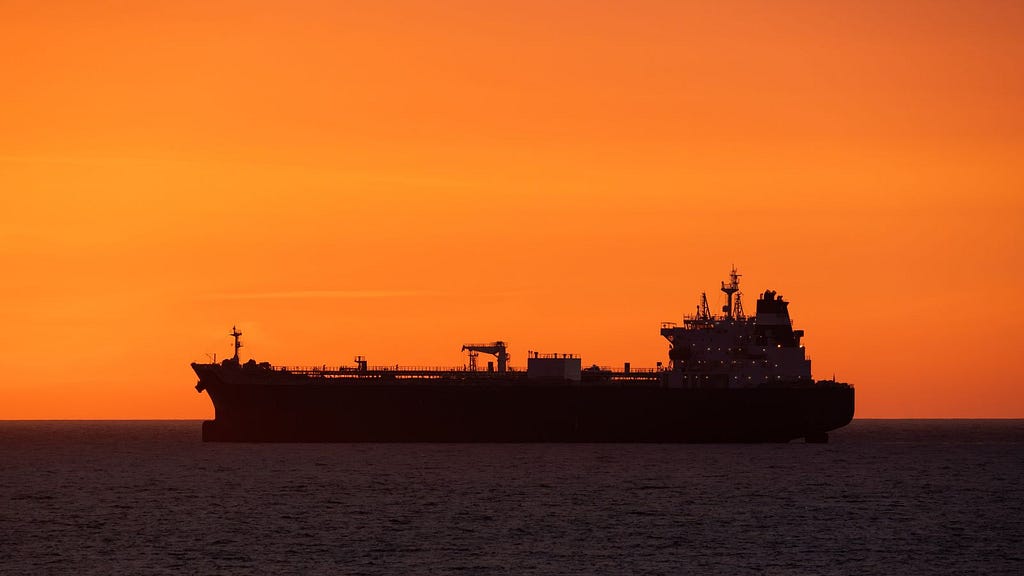
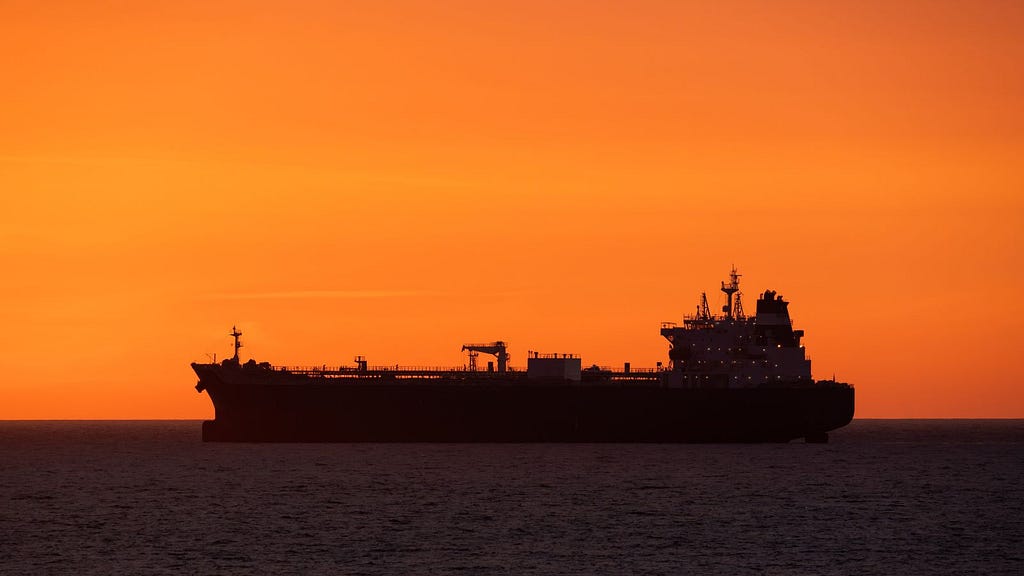
Oil hit $119 a barrel last Monday (Barchart). That’s the headline. Every outlet ran it. The Strait of Hormuz is shut — or near enough — and the world is doing that thing it does every decade or so: pretending to be shocked that a 21-mile-wide strip of water between Iran and Oman (U.S. EIA) controls the fate of the global economy.
Twenty per cent of the world’s oil passes through that gap (U.S. EIA). Or it did, until about a fortnight ago, when the latest Middle East conflict escalated into airstrikes on Iran on 28 February (CNBC), and Iran decided to make everybody pay for it by threatening to set fire to anything that floated through. Tanker traffic dropped by roughly 70 per cent within days, then to zero (CBS News).
So here we are again.
Brent crude — the global benchmark price for oil, the number that sets the mood for everything from petrol at the pump to plastics in the factory — sat at roughly $55 a barrel in late 2025 (OilPrice.com). That was low enough that drilling companies in the US were giving up. The industry was, by most accounts, in a sulk. Then the bombs fell, the IRGC told the shipping lanes to stay clear, and by the second week of March, Brent had doubled, passing $100 for the first time since the early days of the Russia-Ukraine war (CBS News), spiking as high as $119.48 (Barchart) before settling somewhere around $103 (OilPrice.com). The IEA scrambled to release 400 million barrels from emergency reserves across its 32 member countries (Al Jazeera), and that sounds like a big number until you realise it covers roughly four days of global consumption (Al Jazeera). Four days. That’s not a safety net. That’s a napkin.
The US Energy Information Administration reckons Brent will stay above $95 through the spring, maybe settle toward $70 by year’s end — if the war doesn’t drag on (U.S. EIA, Short-Term Energy Outlook). Oxford Economics ran a model where Brent averages $140 for two months — they called it “the breaking point” for the world economy, enough to push the eurozone, the UK and Japan into contraction (Axios). Goldman Sachs nudged recession odds to 25 per cent (Axios). Iran’s Revolutionary Guard, for its part, told the world to expect oil prices to reach $200 per barrel (Al Jazeera). So the forecasts range from “manageable” to “catastrophic,” which is about as useful as a weather report that says “bring a jacket or possibly a lifeboat.”
Look, the panic makes sense on its own terms. The disruption is real. It’s not just crude — Gulf states export 3.3 million barrels a day of refined products, another 1.5 million barrels of LPG (IEA Oil Market Report, March 2026). Eighty-five per cent of the Middle East’s polyethene exports — that’s the plastic in your packaging, your car interiors, your shampoo bottles — pass through Hormuz (CNBC). Qatar declared force majeure on all LNG shipments (Carra Globe). India’s restaurants are under threat due to an LPG supply crunch (CNBC). Cruise ships are stranded. More than 4 million barrels a day of refining capacity is at risk (IEA Oil Market Report, March 2026) because the refineries themselves can’t shift product out of storage tanks that are filling up with nowhere to go. The IEA called it the largest supply disruption in the history of the global oil market (IEA Oil Market Report, March 2026). Larger than the 1973 embargo. Larger than the Iranian Revolution. Larger than anything.
And yet.
I keep coming back to the same question, the one that nobody on the news panels seems to want to ask, the one that sits there in the middle of all this like a door nobody’s tried opening: why does this waterway still have this power?
We have electric cars. Not concept vehicles, not prototypes in a lab in Stuttgart — production cars that outsell their petrol equivalents in several European markets. We have biodiesel that can be made from recycled cooking oil and cuts emissions by up to 74 per cent (The Energy Co-op). We have heat pumps replacing oil-fired boilers across Scandinavia, the UK, France, and Germany. We have bioplastics — PLA from corn, PHA from microbial fermentation (Vertec BioSolvents) — that do the same job as polyethene without needing a single drop of naphtha. We have green hydrogen. We have green ammonia — produced by electrolysis of water, a process that emits no greenhouse gases when the electricity comes from zero-carbon sources (World Resources Institute). We have companies making synthetic petrol from air and water (Zero). We have ethanol that can replace the fossil feedstock used to make ethylene, which is the building block for most plastics on the planet (World Resources Institute).
Every single alternative exists. That’s worth saying twice. Every. Single. One.
So why is a narrow strait in the Persian Gulf still capable of sending the world economy into a tailspin? Because we haven’t bothered. Or rather — and this is the bit that should make you properly uncomfortable — because certain people have worked very hard to make sure we don’t bother.
The fossil fuel industry spent over $150 million lobbying the US federal government in 2024 alone (Center for American Progress). An analysis by InfluenceMap traced more than 50 instances of oil and gas industry groups actively lobbying against green technology adoption going back five decades (InfluenceMap). Fifty. The American Petroleum Institute, FuelsEurope, Fuels Industry UK — they’ve run three plays for over half a century (InfluenceMap): cast doubt on whether alternatives actually work, argue that government shouldn’t pick winners, and warn that switching would cost too much. Solution scepticism, policy neutrality, and affordability concern. The same playbook, recycled like a press release template nobody bothers to update, because it keeps working.
It does keep working. In July 2025, the One Big Beautiful Bill Act gutted the clean energy tax credits from the Inflation Reduction Act (Akin). The wind and solar subsidies — gone. The fossil fuel support was kept. The United States administration’s energy secretary publicly acknowledged that clean alternatives would “fly like eagles” on price alone (Ember), which is a remarkable thing to say while your administration is clipping their wings.
Then there’s the infrastructure problem, which is real and nobody should pretend it isn’t. The United States has nearly 150,000 petrol stations (DieselNet). That network took a century to build. You can’t replace it overnight, and anyone who tells you otherwise is selling something — possibly an EV charger, but still. The existing pipes, the refineries, the tanker routes, the storage facilities — they’re all built for oil. Every oil company on Earth has a financial interest in ensuring those assets don’t become stranded. As one study put it, oil and gas companies tend to favour technologies that don’t fully replace their infrastructure, their expertise, or their staff (ScienceDirect). Which is a very polite way of saying they’d rather the future looked exactly like the past, only with better branding.
But here’s the thing. Here’s the part that gets me.
Jet fuel is hard to replace. I’ll grant that. Sustainable aviation fuel exists, but it’s a fraction of the market, and long-haul flight is genuinely the last fortress of petroleum dependency — for now. Certain industrial feedstocks are tricky. Fine. But petrol for cars? Diesel for vans? LPG for cooking? Plastic packaging? Fertiliser? We have alternatives for all of these. Right now. Today. Not in some speculative 2045 white paper. Today.
Instead of talking about that — instead of the headline being “the technologies we already have that would make this crisis irrelevant” — the headline is the barrel price. Again. Like the weather.
An oil crisis is not a natural disaster. It’s a design choice. We chose this dependency, and we keep choosing it. Every year we let the lobbying stand, every year we fail to build the charging infrastructure, every year we subsidise the drilling and penalise the alternatives. We chose it when we let policy be dictated by companies whose business model requires the world to stay addicted. Now the bill has come, as it always does, delivered via the Strait of Hormuz, which Iran can shut like a tap because we made that tap the only one in the kitchen.
The IEA’s 400-million-barrel release will calm things down. Maybe. Temporarily. The war might end soon — the US President keeps saying it will, though the IRGC doesn’t seem to have received that memo. Prices might settle. The headline will move on to something else, and we’ll all go back to not thinking about where our plastic comes from or why our heating bills track events in the Persian Gulf.
But the door is still there. The alternatives are still there. The question is whether anyone will walk through it before the next time a 21-mile stretch of ocean reminds us, again, how fragile all of this is.
I wouldn’t bet on it. But I’d like to be wrong.
We Have the Alternatives. We Just Don’t Use Them. was originally published in Purpose and Social Impact on Medium, where people are continuing the conversation by highlighting and responding to this story.
