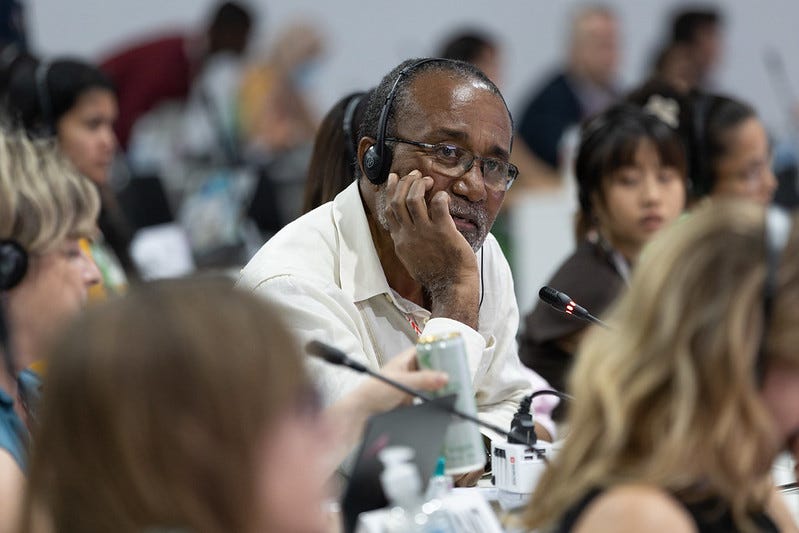
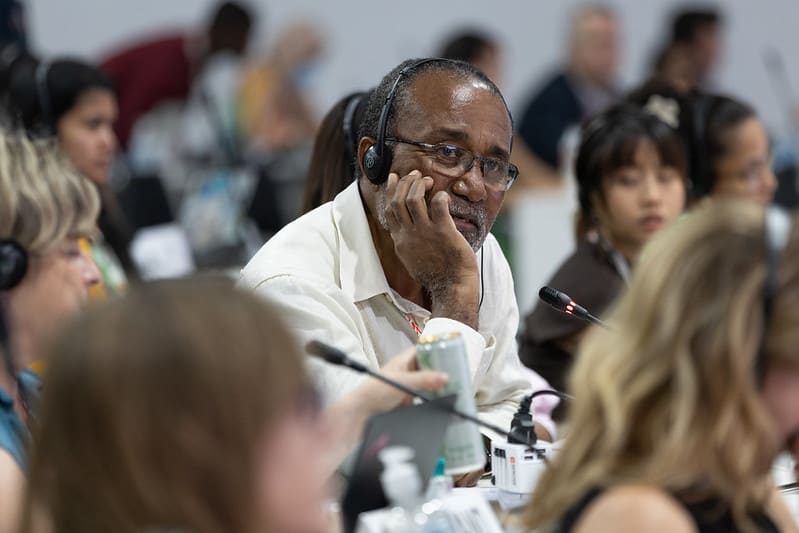
Delegates attend negotiations throughout the day (Photo: © UN Climate Change — Kiara Worth)
On a humid night in Belém, well after the day’s sessions at COP30 had finally ground to a halt, I found myself at a party with a handful of negotiators who were clearly decompressing in the wild way climate negotiators do: by talking about text. Not poetry, not novels, not anything you’d find in a bookshop — just the raw, unglamorous battleground of UNFCCC negotiations. These are the people who spend their days in windowless rooms debating verbs for a living, and they were — against all odds — still laughing about it.
They had spent two hours stuck on the word “acknowledge.” Two hours. On a word that most English speakers barely register.
One of them, who insisted on anonymity because they’d like to be invited back again, confessed they had spent two hours stuck on the word “acknowledge.” Two hours. On a word that most native English speakers barely register. They said it with the look of someone who had survived a spiritual trial.
As a writer, I’ve always assumed I knew my way around nuance. Then I met people who treat a comma the way a bomb disposal expert treats exposed wiring. For them, “acknowledge” is not a harmless politesse. It is a political and legal instrument with implications stretching from Brasília to Brussels. To some delegations, acknowledging something suggests acceptance. To others, it simply means recognising a fact without endorsing it. To some, it teeters dangerously close to an admission of responsibility. And when 194 countries (193 countries plus the European Union) are asked to sign off on the same sentence, every syllable becomes contested territory.
This is the forgotten truth of climate negotiations: nothing is agreed until every country can stomach the wording — and they must stomach it in English, a language in which half the participants are negotiating at a linguistic disadvantage. The power dynamics, the cultural interpretations, the grammatical ambiguities… It’s a stew thick enough to stand a spoon in.
The people who do this work follow the same gruelling rhythm. They start at nine in the morning. By noon, the entire venue becomes a mass migration in search of lunch, which explains why the queues at every café and food stall resemble the opening night of Glastonbury. After the lunch window closes — roughly two o’clock — the negotiators return to the rooms, and they keep going until they either resolve the text or abandon the day in frustration. Some nights end at six. Others at nine. Occasionally later.
So, naturally, after hearing about the hours spent wrestling with acknowledge, I asked another negotiator a simple question: Why on earth do you do this?
This… this feels like it might actually matter to people. To my children. To the places that are already drowning.
They took a sip of their drink, stared at the table for a moment and replied: “Forty-eight weeks of the year, I’m a climate consultant for large organisations. This… this feels like it might actually matter to people. To my children. To the places that are already drowning.”
That answer has stayed with me — because it captures something essential about the COP process and the Bonn intersessionals (known in the trade as the SBs). Strip away the fanfare, the speeches, the theatrical walkouts, and what remains is a small army of people trying, through the chemistry of language, to hold together a global system built on fragile consensus.
Most people assume COP is where the big decisions get made. That’s only half the truth. COP is the pressure cooker — the political finishing line. The moment the ministers arrive, the cameras roll, and the overtime hours begin. But the real text-building, the slow chiselling of meaning and mechanism, happens in Bonn. Those SB sessions are where the skeletons of agreements are picked clean, strengthened, disputed, expanded or quietly buried. By the time delegations arrive at COP, much of the text has already been through two or three rounds of revision.
Now, if the Paris Agreement were a static document — an immovable constitution — none of this would be necessary. But that’s the misconception the public rarely sees. Paris was never meant to be a finished product. It was a framework: a set of guiding principles broad enough to attract universal support, but vague enough to survive geopolitical reality. Everything that came after — reporting rules, the global stocktake, climate finance architecture, carbon markets, loss and damage — needed operational detail. Operational details do not get settled by the stroke of a pen. It gets negotiated. Repeatedly.
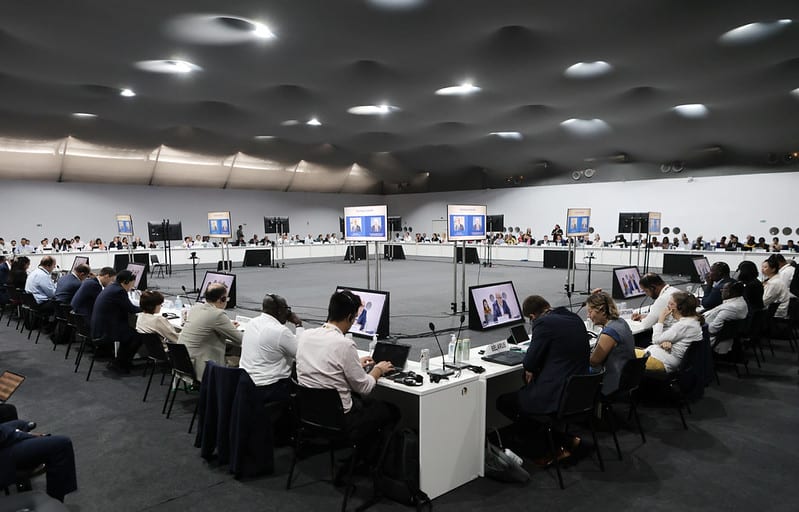
Delegates attend negotiations throughout the day (Photo: © UN Climate Change — Kiara Worth)
The negotiating rooms are filled with what you might call “linguistic archaeology.” A phrase introduced in 2015 might need reinterpretation in 2025. A comma in a finance paragraph might shift the burden of responsibility subtly but significantly. A misplaced verb may accidentally promise what a country cannot deliver. A line that once worked to hold together a divided room might later become an obstacle to ambition. International climate governance is, quite literally, the art of revisiting the past to shape the future.
This is why old texts get reopened. It’s not backtracking. It’s maintenance — like recalibrating a compass because the magnetic field has shifted.
And the magnetic field is constantly shifting. Elections happen. Economies boom and crash. Conflicts flare. New science lands. A term that once seemed harmless becomes politically radioactive. A target once described as “aspirational” becomes existential. The operational machinery of climate policy must evolve with the world that surrounds it. To outsiders, it appears maddeningly circular. However, within the process, this iterative refinement is the only way climate governance can survive.
It is also why the negotiations feel both heroic and absurd. How can a comma take down an entire paragraph? How can a 194-nation consensus hinge on the difference between “request” and “urge”? How can five hours vanish into a discussion about whether to “note with appreciation” or simply “take note”?
Because in the UNFCCC, language is power. And power is distributed through text.
They are — despite the caricature of them as bureaucrats — intensely human.
That night in Belém, as I listened to the negotiators unwind, I realised something else. They are — despite the caricature of them as bureaucrats — intensely human. Some are idealists still holding on to the belief that multilateralism can bend the arc of history. Some are pragmatists trying to protect their countries’ interests without sinking the whole ship. Some are exhausted parents who spend the year working in consulting firms, only to fly to Bonn and then to COP, where they sit under fluorescent lighting without windows, debating whether emissions should be “reported” or “communicated.”
They are not saints. They are not diplomats in the cinematic sense. They are people trapped inside the world’s most crucial group project, desperately trying to stop the climate system from unravelling, one verb at a time.
So the next time someone dismisses COP as a circus or Bonn as pointless bureaucracy, remember the negotiator who spent three hours on acknowledge. Remember the one who told me these weeks are the only time in the year their work feels like it matters. And remember that every year — through this messy ritual of commas and compromise — the texts evolve just enough to keep global climate action alive.
Slow. Imperfect. Occasionally ridiculous.
But alive.
And sometimes, that tiny movement is the most progress humans can reasonably make together.
